 Ihor Tykhonov
Short answer
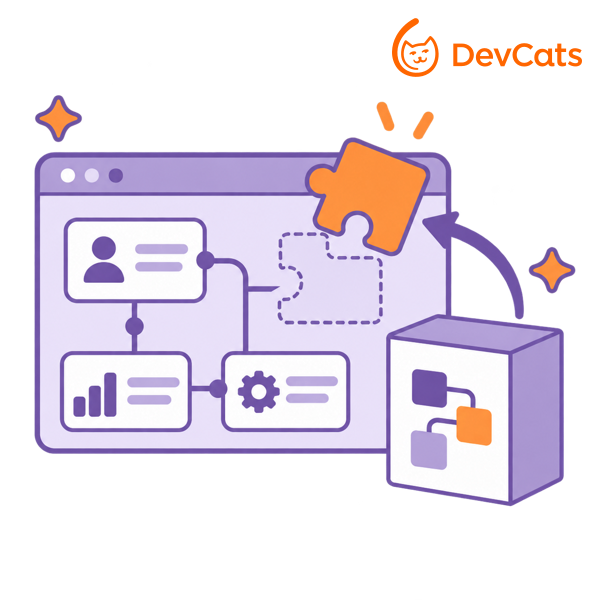
A ready-made CRM is a good solution if its functionality is sufficient to meet your business needs. However, options for adapting such a system to new requirements may be limited, and switching to another CRM in the future may require significant time, resources and money to migrate data and configure business processes.
Developing your own CRM lets you create a unique system fully tailored to the needs and characteristics of your business, without being constrained by the functional limitations of ready-made solutions.
Advances in artificial intelligence (AI) have made custom CRM development faster and more affordable. AI helps reduce programming costs, speed up the introduction of new features and simplify further development of the system as your business grows and its needs change.
A look back.
The CRM development industry has changed several times over the past 20 years, and development approaches have changed along with it. Looking back at the beginning, it all started with individual, custom-built solutions for each business and its needs.
Over time, solutions emerged that aimed to offer universal functionality and attract a broad range of clients. Their major drawback, however, was the limited flexibility to adapt these systems to the needs of a particular business.
On the one hand, the number of features in these systems kept growing; on the other hand – clients often used only a small fraction of them, while those whose needs could not be met by universal CRMs because of their limitations developed their own systems for their business, without unnecessary features.
Today, we have two main approaches: build our own or use a universal solution.

Cost and timelines.
Development timelines and cost – these are the questions that concern businesses most, and they remain just as relevant today.
Before generative AI arrived, developing proprietary systems had become disproportionately expensive over time. One reason for this high cost is the rise in product requirements, driven by an evolutionary process and accumulated knowledge about what a CRM system should be and how it should address business needs.
Just 20 years ago, you could build a simple user login and a few functions inside the system, and everyone would be delighted with those capabilities. Today, providing even the minimum set of necessary features in a custom-built CRM requires hundreds of hours of analysis, a written specification and code.
Development time – this is a cost that businesses cannot always afford. Pricing is an individual matter: every development team values its work differently, and every business assesses the value of its product and its financial resources in its own way.
Businesses therefore gradually began moving from expensive custom-built systems to ready-made solutions, where they pay for the number of users and the modules (plugins) connected to the system.
This approach makes it possible to introduce a CRM into a business process fairly quickly, but it also requires compromise: if the system cannot do something, or does it differently from what the business needs, the business itself tries to find a workaround, justifying this with the financial rationale behind its chosen approach.

History repeats itself.
Now we come to the most pressing question: which approach should you choose in the age of artificial intelligence (AI)?
Writing code itself has become significantly faster. The remaining question is the quality and speed of communication between developers and the business. If that communication is established at a good level, development speed is no longer a drawback. At the same time, the cost of the final product decreases, because building your own CRM from scratch is no longer as time-consuming.
Of course, it is important to recognize that AI-generated code can be of low quality in terms of vulnerabilities. Not long ago, I wrote an article about this based on Veracode’s 2026 research.
However, for an experienced development team that actively uses AI, this is already a resolved issue, because we know what to do and how to do it to keep the product and its data secure.
In other words, if the equation holds that development takes less time, costs less and results in a secure CRM system, what arguments remain against creating a product for your own business?
Your own system will fully handle every task with any data, support any processes at any scale and be convenient for its users. And thanks to the speed of introducing new features, scaling it for your business will become a pleasure at a reasonable cost.
It turns out that history repeats itself, and the arrival of artificial intelligence has made developing your own CRM system economically justifiable.
Conclusion.
I believe there is still a small window of opportunity for universal CRM systems that have been built over all these years and have been the optimal solution for businesses. They simply need to establish communication with their clients so they can sell them the option of integrating features for specific business needs.
If this does not happen, companies that find the features of universal systems insufficient will have every reason to develop their own CRM systems.
Those who are only planning to implement a CRM system should start seriously considering creating their own product, one that stores data securely and meets 100% of their business needs without compromise.
It is fascinating to watch this evolutionary process.
If you need CRM development tailored to your needs or want to put an existing system in reliable hands, get in touch with us. At the very least, a free consultation and an analysis of your needs will certainly be worthwhile.
Thank you for reading to the end.
I hope you found this information useful!
Updated:
Frequently asked questions
When is a ready-made CRM a good fit for a business?
A ready-made CRM is a good fit when its features cover the main business needs and it can be quickly integrated into business processes. When choosing one, also consider that as new needs arise, the business will not be able to extend the functionality of a system it does not own.
When should a business consider building a custom CRM?
Consider a custom CRM when standard systems lack the capabilities you need or their limitations get in the way of your workflows. Rapid advances in AI-assisted development have made building a custom CRM affordable, making it an option worth serious consideration today. A custom CRM will meet 100% of your business needs and can be extended as new needs arise.
How does AI affect CRM development cost and timelines?
AI speeds up coding and can reduce development effort. Analysing business needs, agreeing on requirements and checking quality still take work. The final timeline and cost depend on the scope and communication between the business and the team.
Is a CRM built with AI secure?
Using AI does not guarantee security on its own. The team developing the CRM needs sufficient experience to ensure the security of the code and data, and must carry out appropriate testing after developing and implementing new features.

